

Churches and Cemeteries
Unto the Hills
A Church History by Norma and Stuart Geggie
The Presbyterian Church

...AND BEHOLD THE BUSH
BURNED WITH FIRE
BUSH WAS NOT CONSUMED.
EXODUS 3:2
The first settlers in New France were French Presbyterians, in the 1600s, Huguenots, escaping persecution in their native France. However they were decimated by disease and famine. Scottish Presbyterians arrived in the 18th century, firstly to Nova Scotia, and then to Upper Canada, and amongst them, ministers of the Presbyterian Church. There were divisions within this offshoot from the Church of Scotland, calling themselves Free Presbyterians.
The Rev. J.L. Gourlay, A.M. wrote in his ‘History of the Ottawa Valley’, published in 1896, the following tribute: “The early settlers of Wakefield and Masham were nearly all raised and trained in the Irish Presbyterian Church, one of the best schools for forming the minds of orderly Christians. The Scotch element was small but good.”
The first organised Presbyterian church in the county of Ottawa was in Wakefield, in 1846, Masham being a preaching station, The minister, the Rev. John Corbett, a native of Ireland, was 36 years of age when called to the charge. The Rev. Gourlay who was present at his ordination, wrote:
‘... Mr. Corbett’s attainments were of a moderate order, yet the church grew under his ministry. Masham from a little station developed into a large one. Wakefield church at the Peche was a long time the largest portion. Now Masham is the greater. It is a fine church and a wealthy congregation in appearance. The settlement has good land, well cultivated and exhibiting all the signs of prosperity .. . The first Free Church Presbytery formed here was that of Perth, and the first ordination in it was the Rev. John Carbett... (he) was sent to Wakefield and accepted there... The salary was four hundred dollars, a small amount compared with our days. The congregation never got any aid in raising the minister’s salary. There was nothing provided yet by the church to assist the feeble. The settlers were not wealthy for many years, and they had much hard work clearing land, cutting logs, making timber, securing clothing and provisions for numerous families. The place was healthy and prolific... For the new minister the people could raise only a very limited salary, but they seemed always to do their best. Mr. James Maclaren always did a great deal of good for the congregation and very much for the minister’s salary. One advantage they always had a good working session.’
At the time that Mr. Corbett was “regularly installed in the Presbyterian Church of Wakefield and the adjoining Townships” the certification was signed at “Wakefield, Gatineau River,” 27th January, 1847, by:
Foster Moncrieff, John Nelson, James Maclaren, John Maclaren, James Somerville, William Gibson, Samuel Gibson, William Fairbairn, Thomas McNair, John Pritchard, Andrew Ferguson and David Blackburn.
The charge was that of Wakefield-Masham, but there being no Presbyterian Church closer than Ottawa, Mr. Blackburn, who lived at Cantley, walked or rode to Wakefield and led the singing. The church recorded in the 1851 Wakefield Census Return may have existed when the Rev. John Corbett arrived, however, a log building on the point of land east of the highway was used as the original church. A poem found by Mrs. Reby Dodds among papers of her great-uncle G.B. Johnston, reads:

Old Presbyterian Church Pasche
Tis not romance or even fable
That Church has now become a stable
Though desecrated as a shrine
Twill show the days of Old Lang Syne
Symbolical ‘tis no transgression
When viewed in light of a succession
For lowly in a stable laid
Was Bethlem’s Lord and Bethlem’s babe.
(signed) S.T.
Samuel Teeson was a Methodist minister at Pasche (Wakefield) in 1869. The poem is written in a hand very similar to that of Mr. Teeson’s in early church records.
The first service at Masham was held in the log school house on the farm of Joseph Shouldice, with tallow candles being used for the evening service. Brass candlesticks were presented later by Robert Kennedy.
The first baptism performed by Mr. Corbett on the 16th May, 1847, was that of the son of Robert Kennedy, farmer of Masham, and Sarah Jane Graham (both of whom had worked previously as weavers with the Wrights in Hull.) The child was named John Corbett Kennedy. Many baptisms followed that year, including the seven children of John Anderson and Elizabeth McArthur of Masham, who ranged in age from newborn to eleven years. In 1851 Mr. Corbett and his wife lived with their four children in the “parsonage house” on Range 1, part of Lot 1, on one half an acre cultivated into garden (orchard.) In the 1842 census Foster Moncrieff had one hundred acres, range 1, lot 1, and in 1851, ninety-nine and a half acres, so that the Presbyterian Minister's land was probably carved out of this choice acreage on what we now know as “the McClinton farm” on Rockhurst hill. Mr. Corbett produced thirty bushels of potatoes, one barrel of pork, and he had one horse. This would have been an essential part of equipment for a man of the cloth, as he must have spent a considerable amount of time on horseback. He travelled by this means with the Rev. Gourlay in 1856 to call on settlers and conduct services in isolated areas. They passed through the sparsely populated area between Farrelton and Low, and the hair-raising description of crossing Stag Creek follows:
‘... one horse was sent through and caught by the first man, and the other sent after at a safe distance and followed not too closely by the second man. The little horse half waded, half swam, the tall one threw mud high and far in his passage through. The saddles had to be carefully wiped with leaves to allow a remount; sometimes we took the narrow paths around these deep pits, through the tall brush, pushing through between a large tree and a perpendicular rock, with our toes held pretty near the ears of our horses to keep from being rubbed off.’
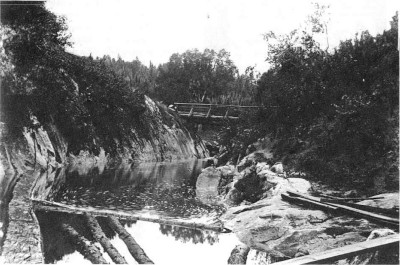
They called at the Hamilton farm where Mr. William Leslie and his wife (a Miss Gibson from Masham) were in residence, on to Kazabazua, then to Mr. Ellard’s “select settlement” and Pickanock. Their mode of transport at times was a bark canoe, and on arriving at a little log church for a service, they were greeted by the sight of a whole fleet of bark and log canoes. These ministers were treated with great hospitality, their visit no doubt an occasion in these isolated areas and many were forced to stand outside during the religious services for want of room. When they arrived by canoe at Aylwin in the rain, the schoolhouse where the service was to be conducted was packed, some standing on benches and covering the desks, and after the service by dim candle-light, people stood around eager to greet each other before scattering to their homes. Their travels took them above Maniwaki (then a smaller settlement called Desert,) to Bouchette. Possibly with some bias, the Rev. Gourlay considered that the lumber companies were to be congratulated in having so many reliable Presbyterians in their employ.

The frame church at Wakefield with a capacity of one hundred, which existed in 1851, had been replaced within the next ten years by one double its size, and it is most likely that this was on the site of the present United Church in Wakefield. This property was sold by James Mclaren, acting for David Maclaren, his father, in 1859, for the price of five shillings. James Reid, John Stevenson and John Pritchard signed the document as Trustees. Also the first Presbyterian Church in Masham was built in 1861. Robert Earle was the contractor, while Samuel Marshall and William West were carpenters. This was a frame building at “the lake settlement,” that is, overlooking Fairbairn (Reilly’s) lake. A cemetery and a school and Orange Lodge stood nearby. In 1871 the church interior was enlarged by the removal of a partition at the end, providing space for more seats. A Committee of Church Managers, William Leslie elder, William Bennett and James Pritchard, were to superintend the practicability of this being done “without injury and with not too much expense.” This church building remained past the turn of the century, and was latterly used for storage of hay before its demolition. In 1860 the elders for the Wakefield-Masham congregation were James Pritchard, James McNair, Thomas Stevenson and Robert Kennedy.
There were 201 Free Presbyterians and eight members of the Church of Scotland in the Wakefield census, and in Masham, 309 Free Church Presbyterians and nine Church of Scotland. The Rev. John Corbett had indeed “built up the Church” during his fifteen year tenure of office. He was replaced in 1862 by the Rev. Joseph White, who remained until 1876. The Rev. White apparently travelled extensively, as had his predecessor, since he continued to supply Aylwin during all of his term. He was a native of Scotland, and was thirty-one years of age when he arrived in Wakefield, his wife Elizabeth was twenty-seven, Mrs. White was much loved by members of the community who were saddened by her death at the age of thirty-six, in 1871, after the birth of her sixth child. The little girl, also Elizabeth, died a few weeks later. Mr. White was to remarry before he left the charge.
The Session concerned itself with the morals of the congregation, and conscientiously considered and answered questions on the “State of Religion” as set down by the Assembly. These read:
- Do those members of the Church who are parents regard it as their duty to bring their children to Jesus? .... Yes.
- Is family worship observed during morning and evening in the houses of the members of the Church?... The majority do observe family worship.
- Are prayer meetings held within the bounds of the congregation, and if so are they attended?... Yes, and poorly.
- Do members of the Church work for mutual edification and for the conversion of others?... Generally they do.
- Do they afford evidence of feeling their responsibilities as stewards of Jesus Christ by giving of their substance as God has prospered them?... Some do and some do not.
- Are the Sabbath Schools well attended, and do the teachers aim at the conversion of their pupils?... Considering the scattered nature of the congregation, pretty well attended.
- Is the Shorter Catechism used in the families and in the Sabbath Schools?... Yes.
- Is there any marked change in the religious condition of the congregation during the past year?... Yes the numbers added during the year much larger than usual. Some of those brought to confess Christ gathered from among those more than usually careless. On the part of some, a great willingness to work for Christ. The contributions for religious purposes more numerous and larger than usual.
- Do you know of any cause which seems to prevent the young from receiving the Gospel and openly confessing Christ?... Nothing in particular but what is common to fallen human nature.
- To what extent does the sin of intemperance prevail in your neighbourhood, and what proportion of the members testify against the drinking usages by total abstinence from intoxicating drinks?... Of Church members in full communion, at least two-thirds are total abstainers, whilst it may be noted that nearly all the young persons not in full communion with the Church are total abstainers.
In 1863 a resolution was made deploring the practice of dancing, and forbidding it. Ten years later this was still a concern, and mention was made of “the danger to spirituality of mind arising from attending dancing parties either to participate in this amusement or to be an onlooker in connection with it.” In the Session minutes it went on record that... “it (dancing) was held to be an amusement of such nature as to call for remonstrance on the part of Elders and if persevered in by members, leave them open to discipline by the Session.” Also of concern to the Session were specific cases of drunkenness, dishonesty and “sabbath breaking,” as well as the reported adultery between a couple prior to their marriage. In turn each offender was visited by one or two Elders, and if repentance was not apparent, he or she was summoned to appear before the Court of Session. In many cases there was a confession of guilt and a promise to mend these wicked ways. When met with a defiant attitude or a refusal to appear before the Session, a member would be denied Church privileges for a period of three months to a year. In an extreme case the offense, together with the judgment of the Court of Session, would be read publicly from the Pulpit. Although this may appear to be something of a witch hunt, the attitude of these Elders was one of concern and compassion for the large congregation for which they were morally responsible. Session minutes record these instances: The needy circumstances of a resident of the community was discussed, and he was to be furnished with one barrel of flour, the expense of which was to be defrayed out of the Sabbath collection. A motion in the session minutes was unanimously carried:
... that this session desires to recognise the striking dispensation of Providence in the hand of a Sovereign and all wise God with which he has been pleased to visit this congregation in removing from its midst on the 25th March, 1868, Mr. John Lambert an adherent of this Church, his six sons and one daughter by the burning of their dwelling amid the flames of which they all perished. The Session would also recognise God's goodness in the deliverance of Mr. Lambert's daughter Isabella, a girl of about sixteen years of age, from sharing her father’s sad fate and to her as well as her elder sister Mrs. Templeman and her husband, would extend their cordial sympathy and strengthen them, and submit to His Holy Will and say in the spirit of Christian resignation, “the Lord gave and the Lard taketh away, blessed be the name of the Lord.”

They recommended as Guardians for Isabella, William D. Leslie and James Dunkin from the Session, and John Maclaren from the Congregation. The next collection was to be “for widows and orphans.” Collections at other times included: Montreal College, $29.86; French Protestant Evangelization Scheme Home Mission, $29.90; Kankakee and Foreign Missions, $34.00 and $25.00. In 1871 the Session agreed to recommend China as the field to which “the missionary to foreign field” be sent.
At about this time there were 235 communicant members listed on the roll, and the quarterly Sacrament Service was held alternately at Masham and Wakefield. In 1868 the members’ roll recorded 121 members having sat down to the Lord’s Table. On the Friday prior to Communion Sunday, members wishing to join the Church were examined by the Session, and at the pre-communion service which followed, tokens were distributed. These were collected at the Service of the Sacrament of the Lord’s Supper so that the Communion Roll attendance could be kept. If a member was absent for four consecutive Communion Services, he or she was visited by an Elder responsible for that district. There were eight districts, and the Elders responsible for each were: James Reid, Thomas Stevenson, James Robertson, Thomas McNair, James and John Pritchard, Robert Kennedy, William D. Leslie, and James Dunkin. This was the “good working session” to which the Rev. Gourlay had referred, and their work was commended by the Ottawa Presbytery when they met in the Wakefield Church in 1870.
‘The Presbytery after deliberation desire to express great satisfaction with the state of the congregation as shown in the Presbyterial visitation.
The prosperous state of the congregation spiritually calls for devout thankfulness to the great Head of the Church and earnest desire for a continuance of His Favours. The great amount of energy put forth by the Pastor to overtake the very laborious and extensive work of his charge deserves special notice. The attention to visitation by members of the Session, as well as the exertion in Sabbath Schoo! work, merit commendation; while the healthy state of the congregation financially, the care for the various schemes of the Church with the proposed addition to the Pastor’s stipend are very gratifying. The Presbytery would however recommend to the consideration of the congregation the strong and increasing claims of the Schemes of the Church and the necessity for a more general contribution for members and adherents according as God has prospered them.
The question of leading in the Service of Song is one which demands the attention of the congregation. In view of the interests of the Church in this place, the Presbytery rejoice to hear of the proposal to erect a more commodious place of worship and trust that the congregation will proceed with all diligence to carry the proposition into effect.”

The achievements of this young congregation within twenty-five years of the arrival of their first “pastor” are very impressive, and the great individual contribution by the Elders and the minister are apparent. The former lived over a very scattered area in the two townships; they continued to serve as Elders for more than half a lifetime, at a time when distances were sometimes tripled by lack of roads and bridges. Thomas Stevenson’s home was three miles east of the river, so that his attendance, almost perfect for close to fifty years, entailed a four mile ride to the scow at Copeland’s landing a couple of miles south of the village. For the evening pre-Communion Service in March, which was held in Masham, this river crossing must have been undertaken at times at some risk and perhaps by foot when the spring ice was not strong enough to support a sleigh. The traveller possibly would have been met by some vehicle on the opposite side, and transported the further six miles to Rupert, and then home late at night by the same long and precarious route.
There were no organs allowed in Presbyterian churches at this time; no hymns were sung, just psalms. In 1867, in an effort to improve the singing, a committee was set up to ascertain what might be done in the way of “getting the means and to engage a preacher for three months as early as the ensuing summer or autumn and to teach two or three evenings in each of the churches”. They were authorized to engage a competent person if they saw fit. Perhaps it seemed providential that in 1868 John Edmond joined the staff of Maclaren’s as a miller. A devout Presbyterian, he “led the congregation in song” with the use of a small tuning fork, still in the possession of his daughter, Mrs. Bernard Sully (Elsie Edmond). This same year the controversial subject of instrumental music in the Worship of God was voted on in Session, with the resulting vote that “congregations unanimously desiring it be afforded this liberty provided they (had) the consent of Presbytery to such an introduction”. However, not until 1873, did St. Andrew’s in Wakefield, install its first organ. At this time, Mr. Edmond was presented with a bible in appreciation of his “leading the Service of Song”. In 1869 a request was made by John Pritchard and James Dunkin for the use of the church in Masham for singing classes of sacred music to be conducted by Mr. Sinclair. By 1870, Session meetings were being constituted with singing, scripture and prayer. It was agreed to change the old hymn book then in use for the new one sanctioned by the General Assembly, and that the congregation be notified of the change. The new hymn book was to be introduced by the 1st of June, 1882.
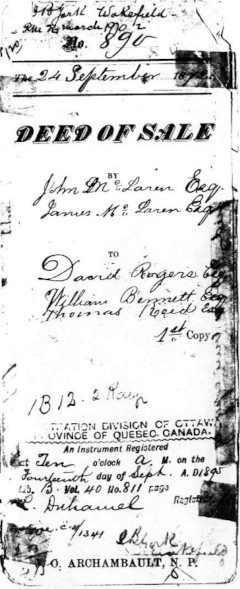
In 1867, property had been purchased from David Maclaren for the “sole use and benefit of the congregation as well as for the site of a church, chapel or school house, burjal ground and residence for minister of said congregation”. This area, more than two acres, was purchased at a cost of forty dollars. The very choice property, bordering the Gatineau River, was banked in the rear by a grove of tall pines, and the fine home, which was subsequently constructed against the hillside, had a view down the river. This served as the Presbyterian Manse and later that of the United Church for ninety years, when it was sold and a new manse built in a more central location. The original “Manse” is now the property of Mrs. Jane Hunt. Four years after this property was procured, the frame Presbyterian Church in the centre of the village was replaced by a brick building costing $7,500.00. James Robertson, who was employed by James Maclaren and Co., was loaned by his employer as overseer for the building of the church. A further strip of property had to be purchased to give a fifteen foot clearance around the foundation which was 40 x 63 feet. St. Andrew's Presbyterian Church, with its balcony and recess for a pipe organ to be provided in the future, had a tall spire which is a focal point in early pictures of the village.

The congregation in Masham, having enlarged their existing church building this same year, contracted with Samuel Hutton for a new brick church in 1882 at a cost of $2,500.00. The settlement at Rupert was moving away from its original centre at the lake, and so the new church was closer to the community which was building up around the “corners”. The Session discussed the mode and manner of laying the cornerstone of this new church, before deciding to leave this to the Building Committee. However, they apparently decided against the cornerstone, placing the date, 1882, above the main doors.
The Rev. George Bayne was the minister at this time. Authorization was given to have the Congregation name changed by Presbytery from Wakefield to Wakefield/Masham. Session was to meet every second month (instead of monthly) alternately in each church. There were a total of ninety-three families in the congregation, and between sixty and eighty communicants partook at the Sacrament of the Lord’s Supper. In 1883 the total amount raised by the congregation was $3,666.00. Twenty-five dollars was sent from the J. Maclaren and Co. “Opennecon” Farm; five dollars of this was appropriated to the Schemes of the Church, and twenty dollars to the stipend account. For one year the Schemes included:
| Home Mission | $15.00 |
| Foreign Mission | 15.00 |
| French Evangelization | 12.00 |
| Presbytery Fund | 9.00 |
| Aged and Infirm Ministers | 5.00 |
| Manitoba College | 3.00 |
| Widows and Orphans | 3.00 |
| College Fund | 5.00 |
| $67.00 |
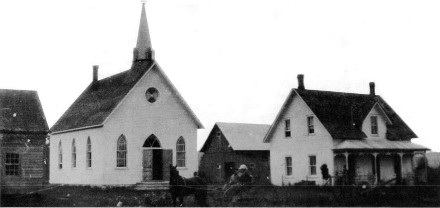
The new population of Presbyterians who made up the congregation of the newly-built church in Masham lived in the northeastern corner of the Municipality and were all English speaking. However further west, beyond the French Roman Catholic settlement at Masham, was a small dissident community, which probably arrived shortly after their neighbors, and were referred to by them as “les suisses”. A.F. Duclos had a store and later a post office at this point, and the settlement became known as Duclos. There is no record of a church having been built here in the 1871 census return, but, in 1883, the minute book of the Wakefield/Masham Presbyterian Church records a meeting with the congregation in their “Protestant Church in the Parish of Ste. Cecile de Masham” for the purpose of electing Elders. Nominations from the congregation were Louis Giroux, A.F. Duclos, Samuel Lord, Madison Duclos and Joseph Giroux. Two weeks later the ordination of Louis Giroux and induction of A.F. Duclos into Eldership took place. The Rev. M. Amie, pastor of the French Congregation in Ottawa, attended and addressed the congregation in French as well as acting as interpreter. The Rev. George Bayne, Moderator; James Dunkin, Clerk; and Messrs. Robert Kennedy and William Bennet, Elders of Session, took part in the ordination service. It was to be known as the First French Presbyterian Congregation of Masham, and A.F. Duclos was to act as the Clerk of Session. The neat wooden church with spire, and the parsonage next to it, stood beside the road between Masham and Duclos. The cemetery still remains, and memorial services were held there annually until the 1960s, but the buildings were taken down about thirty years previously.
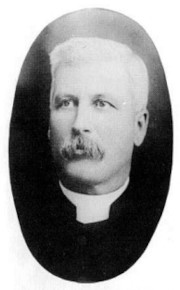
The Rev. Robert Gamble came to the charge in 1884 and remained for thirty years. He also served as Clerk of the Ottawa-Presbytery for thirty years. It is not surprising that over this lengthy service in the community he grew to know three generations of his “flock”. Two years after his ordination he married Miss Adelaide McGillivray, who was a sister of Mrs. David Maclaren, also of Wakefield. The Rev. and Mrs. Gamble had five daughters. The family is well remembered by elderly residents — the jolly times with “the Gamble girls” — the kindly manner of the tall big man — his long and outstanding service to the community.
In 1896, after twelve years as minister of the Wakefield/Masham charge, an unusual recognition was made by the Session. It was moved by T.A. Stevenson, seconded by Robert Moncrieff, that the Moderator (of the Session), be granted two or three weeks of holidays “in token of our appreciation of his service as Pastor of this congregation” and that he would try and find supply for the pulpit during his absence, it would be paid for by the congregation. Those serving as Elders at this time were:
| James Pritchard | David Rogers |
| John Pritchard | Thomas Stevenson |
| James Dunkin | James Reid |
| Robert Kennedy | Robert Moncrieff |
| James Stevenson | I.B. York |
| John Edmond | Thomas Reilly |
| George Townsend |
In 1904 the Session met in the home of Mr. I.B. York. Present were the Rev. Robert Gamble, and Elders John Edmond, James Stevenson, and Mr. York. Miss Florence Mabel York, who through serious illness was unable to attend services, was received into full Membership. The Sacrament of the Lord’s Supper was administered to her, together with seven other members assembled for the occasion.
Weddings generally took place in the home of the bride, but apparently baptisms were held in the church. However, some years previously (in 1871), a petition from Robert Ardies was granted for the privilege of having his child baptised “in his own domicile”, owing to his being a toll-gate keeper on the road to Ottawa.
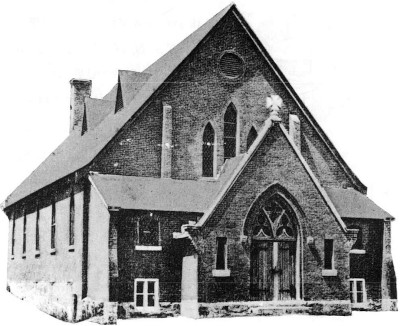
On the 20th June, 1904, a fire, starting possibly in the stable of the hotel directly south of St. Andrew’s Presbyterian Church in Wakefield, swept through part of the village, destroying several businesses and residences. Despite strong winds which fanned the flames, the brick walls of the church withstood the blaze for several hours, but finally it too fell victim, and the exhausted villagers who had worked incessantly with buckets from the river, watched as the church was gutted.
Built in 1871 St. Andrew’s was capable of seating four hundred people. Of the two organs, the one in the choir loft was saved. Mr. York was quoted in the newspaper report of the day, as saying that the congregation would rebuild at once, and that a meeting had been called to take the preliminary steps. The Methodist Church had narrowly escaped destruction in the holocaust, the fire having stopped at Mr. Poole’s residence and harness shop, one building north of this church.
The Wakefield/Masham Session minutes recorded a motion of appreciation of the kindness and generosity of the Methodist congregation in giving the use of their building to hold services. The new brick Presbyterian Church, constructed on the previous foundation was dedicated in February 1905, and is the present St. Andrew’s United Church.
The following entry appeared in ‘The Presbyterian’ on July 16, 1904 (page 79):
We regret to announce that the fire which swept away part of the village of Wakefield a couple of weeks ago, destroyed the Presbyterian Church. Rev. R. Gamble has the warmest sympathy of his brethren in the misfortune which has befallen him in his work. There are few ministers in the Presbytery whose ministry has been more constant and efficient and few more thoroughly liked than our esteemed Clerk of the Presbytery. We understand that a new church is already in the process of erection.”