
Churches and Cemeteries
Unto the Hills
A Church History by Norma and Stuart Geggie
Church Organizations

TAKE MY LIFE AND LET IT BE
CONSECRATED, LORD TO THEE.
(HYMNARY)
FRANCES HAVERGAL. 1836-79.
Women’s Organizations
From an early stage the women played an important roll in the social life of both churches in each community.
Although there is no evidence of their being formed into organised groups, they would have been very active in such social gatherings as the teas served to several hundred people who attended the dedication of the Methodist churches in “Pasche” in 1864, and in Rupert in 1874. Harvest Home Festivals with an admission fee of twenty-five cents, were held at Hall’s Grove in the 1880s towards the cost of the Rupert Church.
A Ladies’ Aid of the Methodist Church in Wakefield was in existence in 1912 until 1925, with Mrs. Sam Kennedy as president, while Mrs. R.J. O’Hara presided over the North Wakefield group in 1919. The Ladies’ Aid Society was first organized in connection with the Presbyterian Church in Wakefield in 1896, under the guidance of the Rev. Robert Gamble. They met monthly, charging a fee of fifteen cents to join. At the first meeting, in the home of Mrs. I.B. York, nine ladies were present, and Miss Annie Stevenson (later Mrs. John Edmond) was the president, with Mrs. George MacAfee, secretary/treasurer, Their money-raising activities included quilting, collecting donations in money, sewing fancy work, selling photographs, and conducting ice-cream socials. Following reconstruction after the fire, the women worked towards paying interest on the church debt; $45.00 in 1906, $175.00 in 1908. During the war years of 1914-18, they directed their energies towards working for the Red Cross.
When this group met for this first time in 1919, they adopted the name of the Willing Workers’ Guild, and nominated Mrs. Charles Stevenson as president; Miss Robb, secretary; Mrs. R.S. Johnston, vice-president; and Mrs. Mabel O'Hara, treasurer. They had twenty-nine members, paying twenty-five cents “dues”. Their work during the next seven years included the usual quilting bees and sewing, as well as holding lawn socials and concerts. Expenditures were made towards hymn books, centre lamps for the church (in 1923), a life membership in the W.M.S., payments on a piano, and towards a fund for a new organ, assistance to the Sunday school and the China Famine Fund.

At their final meeting on December 30th, 1925, the President, Mrs. Cuthbertson, and past-president, Mrs. Charles Stevenson, were presented with silver candlesticks. The meeting adjourned “to meet at the Manse at a date to be set by the Rev. J.R. Morden, when our Guild will unite with the Ladies’ Aid of the former Methodist Church to form a working society of the United Church of Wakefield”.
This meeting, on January 13th, 1926, formed the Ladies’ Aid of the United Church of Wakefield; their object: “to assist in all improvements in the care of Church and Manse, and to assist in any activities the Church deems necessary”. It had as its officers, Mrs. Sam Kennedy, president; Mrs. H.W. Cuthbertson, and Mrs. Austin, 1st and 2nd vice-presidents; Mrs. O’Hara, treasurer; and Mrs. W. Thorne, secretary. Committees were formed to supply flowers for the church, to visit the sick, and to be responsible for “work”. Money was spent on books for the sick, flowers, assistance in paying bills of hospitalized people; and paint for the church.
The financial statement from a lawn social held by the L.A. in 1926 showed:
| Receipt at gate | $88.00 |
| Sale of fancy work | 47.95 |
| Ice-cream and lemonade | 13.45 |
| Bran pie | 19.44 |
| Cake and bread sold | 2.45 |
| Total | $171.29 |
| Talent 3.00, phone messages .50 | $3.50 |
| 31 lbs ham at .36 | 11.16 |
| 5 Ibs creamery butter .33 | 1.65 |
| Paper plates 3.15, sugar .14 | 3.29 |
| Tea 1.13, bread 1.80 | 2.93 |
| Baking ham (Mr. Orme) | .50 |
| Lemonade material | 1.53 |
| Ice-cream 3.15, cones .90 express 1.45 | 5.50 |
| Bran pie expense | 6.53 |
| Material for fancy work | 1.60 |
| Total | $38.19 |
| Net gain: | $133.10 |
Similarly, the women belonging to the Rupert Ladies’ Aid or the “United Aid” (from 1925), met in the homes of members during the winter months and in the church hall in summer. Mrs. R. Craig, their first president, served as such for seven years, Mrs. A.F. Shorten was the honorary president; Mrs. Gibson, vice-president; Mrs. J. Nesbitt, treasurer, and Mrs. R.J. Moore, secretary. There were twenty-six members in their first year. The Harvest Home supper brought in $55.30 with expenses of $12.00. In 1929 the Rupert Ladies’ Aid purchased a building from Mr. Joe O'Hara to be moved and used as a kitchen for the community hall.
At Alcove the ladies worked for their church, and together with the Rupert L.A., shared the cost of improvements and conviences for the parsonage in Alcove. In June 1929, all three “Aids” enjoyed a lawn social at the home of Mrs. Adam Prentiss, with forty-three people attending. There was a notation of such a “pleasant time spent by all, everyone enjoyed the good ‘eats’, especially the ice-cream on such a hot day”. The following year this courtesy was returned, when the Alcove and Rupert ladies were the guests of the Wakefield United Church L.A., sixty in all, on Mrs. Austin’s lawn. Such annual occasions were highlights in their weeks of loyal work. Occasionally a president of long standing would leave and be honoured. Mrs. Sam Kennedy had served as president of the Methodist L.A. from 1912 to 1925, and then of the United Church L.A. until her departure in 1930, when a presentation was made of a desk pen.
The activities of the groups were similar to those fifty years later, only the costs differing. For example, in 1929 the Wakefield L.A. served supper to one hundred and twenty-five men of the Masonic order; the menu: ham, salad and ice-cream, at seventy-five cents each.
In March of 1932, a letter was read regarding the urgent need of relief in the West. Once again the war years brought contributions from the Auxiliaries, of gloves and socks; and letters were received from boys in the Services acknowledging the receipt of parcels. Despite the war years, there seemed to be no relaxation in the endeavours on the home front. A sample of a year’s activities of one unit in 1944 showed an average attendance of thirteen, with meetings rotating in members’ homes, and beginning with a devotional period. On the social side, they had held a tea and sale, a ham supper, a “shower”, and a joint meeting with the W.M.S. Their “work” included many contributions to Manse improvement, varnishing the floor, drapes, paint, a chesterfield suite, hall table, mirrors and pillows. The church floor was painted. Flowers were sent to families bereaved, twenty parcels to boys overseas, two quilts made for fire victims, one quilt for the Red Cross, donations of $10.00 to the Red Cross and $5.00 to the Bible Society.
In 1962 all the women’s organisations in connection with the United Church of Canada joined to become part of the United Church Women. At the inaugural Service, on January 3, 1962, dinner was served to eighty-eight ladies by the Men’s Club. The installation of officers took place in the church later —
President — Mrs. Stan Chilcott of Alcove
Vice-President — Mrs. Millar Gibson of Rupert
Secretary — Mrs. Arthur Broom of Wakefield
Treasurer — Mrs. Bruce Moffatt, Wakefield
Programme Convenor — Mrs. Norman McClinton, Wakefield
To this executive was also added the President of each group — Cascades, Alcove, Rupert, and groups A, B and C (the afternoon circle) all of Wakefield.
The “Afternoon circle” or Circle C of the U.C.W. in Wakefield had as its president Mrs. Bernard Sully. With a membership of twenty-five, approximately sixteen attending regularly, it included some of the older women in the community, and disbanded in 1968 due to the advancing age of its members.
The women in all groups have worked ceaselessly for a variety of causes, support of Camp Bitobi, Brookdale Farm Children’s Home, additions to the churches, Church and Manse furnishings, missions, the Gatineau Memorial Hospital, “Morningside”. Old People’s Home, and many others. They have raised money by serving dinners and teas, and sales of fancy work, etc.
Missionary Organisation
The Women’s Foreign Missionary Society of the Presbyterian Church was first organized in Wakefield in 1886. No records exist of their earliest meetings.
In 1910 a small group of from three to eight members met monthly, Mrs, Robert Gamble was president, and Miss I.H. Macfarlane, secretary. They baled clothing for the North West Mission, valued at twenty five dollars, and sewed two complete outfits, summer and winter, for an Indian girl aged twelve years: dress, nighties, “waist”, a (purchased) tuque, and hair ribbons.
In 1912 they busied themselves with sewing and packing bales for Missions and reading letters from missionaries in India and North Formosa. The latter, from Miss Adair, was written on Japanese paper and enclosed in a Chinese envelope. It was suggested at this meeting that “Mite” boxes be distributed to each household in the congregation, with a request for two cents per week. A special treat at the same meeting was “some delightful music from the gramophone, very kindly supplied by Mrs. Morrison”. The groups had called themselves the W.M.S. and W.F.M.S.; however in 1914 they officially became the Women’s Missionary Society, with no change in officers from the former organisation. Mrs. Gamble had been in Wakefield for thirty years when she retired in 1914 as president, and was presented with a “silver mounted parasol”. The annual report of the Presbyterian Church of Wakefield/Masham in 1915 had the following entry:
Woman's Missionary Society, Wakefield
Miss M. Clendenan - President
Miss L.H. Macfarlane - Secretary
Mrs. G.H. Earle - Treasurer
| RECEIPTS | |
| Monthly offerings | $26.58 |
| Thankofferings | 34.00 |
| Home Helpers Fund | 18.37 |
| Fees | 4.50 |
| 20 Subscriptions to The Messenger | 5.10 |
| $88.55 | |
| EXPENDITURES | |
| 20 copies Messenger | $5.10 |
| Delegate to Presbyterial | 1.20 |
| Supplies | 1.77 |
| Sent Presbyterial Treas. | 80.48 |
| $88.55 |
Bale sent to Indian School val. at $35.80
Woman’s Missionary Society, Masham
Mrs. William O’Hara - President
Mrs. John R. Nesbitt - Secretary
Mrs. George E. Pritchard - Treasurer
| RECEIPTS | |
| Monthly offerings | $ 7.55 |
| Fees | 2.50 |
| Thankofferings | 21.00 |
| $31.05 | |
| EXPENDITURES | |
| Sent Presbyterial Treasurer | $31.05 |
| $31.05 |
Bale sent to Indian School val. at $20.00
Contributions were made through the “Gospel Teams” in Wakefield and Masham and Sunday schools, and sent to “Dr. Somerville”, a total of $343.91.

At Union, with the Methodist Ladies’ Aid joining the Presbyterian Women’s Missionary Society, the missionary group remained the W.M.S. of the United Church in Canada, with the first meeting on April 13, 1926. Home cooking sales took place in Wesley Hall, formerly the Methodist Church in Wakefield, and meetings continued to include devotional study, taking the form of bible study, early church history, and missionary work in India, China and Japan, and “business”. The meetings, in the Session room during the summer, and in homes over the winter months, had an attendance of eight to fifteen. There was a special fund for relief of Protestant churches in Europe (in 1926). A Young W.M.S. was set up, and the groups sponsored Mission Band, a Baby Band, temperance courses, visiting strangers and “associated helpers”. In 1930 there were twentynine “visits to strangers” made. Delegates were sent annually to the Ottawa Presbyterial Society.
An entry of interest in 1932 gave mention of the making of an autograph quilt — “to have ten autographs per block, in mauve thread, and sashed with mauve broadcloth, a total of thirty blocks”. This was surely a unique quilt amongst the scores of quilts produced over the years by the church women of the community.
Many women gave years of service in office, as evidenced by the entry in 1933 of the Wakefield W.M.S. minutes:
“It is with the very deepest regret and sense of loss that the resignation of Mrs. George Earle was received from the treasurership, which office she had filled faithfully and efficiently for upwards of twenty-five years.”
Mrs. Earle was given life membership in the W.M.S.
In 1950, on the twenty-fifth anniversary of the Society, a special meeting of the Wakefield Auxiliary of the W.M.S. was held at the home of Mrs. John Nesbitt, attended by one hundred per cent of the membership. The hymn and scripture readings were those used at the inaugural service of the United Church W.M.S. (October 25, 1925, at the Bloor Street United Church, Toronto) — “The Church’s one Foundation”, and John 17: verses 1, 2, 6, 17-21. The programme called “Growing with the years”, offered a challenge of the future: “more missionaries, larger givings, more earnest prayer, more devoted study and service on the part of every member of the W.M.S.” The names of the presidents during the twenty-five year period were read: Mrs. York, Mrs. Holden, Mrs. McAvoy, Mrs. Taylor, Mrs. F. Stevenson, Mrs. McCorkell, Mrs. Lloyd, and Mrs. Cuthbertson.
Lily Adair

Miss Lily Adair was born at Three Rivers, Quebec, in 1873, and taught school in Wakefield in about 1908/09. This school was on the Péche Creek close to the home of Mrs. Lyla McGarry.
During her stay in this area, she was a member of the Wakefield Auxiliary of the W.F.M.S., before leaving to join the Foreign Mission Field in 1910. She served in Formosa for thirty years, returning each six or seven years on furlough, and during all of that time and long after her retirement, she continued to correspond with her friends in the Wakefield W.M.S., encouraging them in their assistance to mission work. In honour of her, the Junior W.M.S. group in Wakefield took the name of the “Lily Adair” Auxiliary in 1933.
All groups had the pleasure of a visit from Miss Adair in 1941 after her retirement, when at their May meeting at Rupert, she spoke to a large gathering on her thirty years work in Formosa.
Miss Adair’s letters continued to delight the women. At the age of ninety-four, with her eyesight and hearing failing, she greeted the Wakefield Lily Adair Auxiliary at Christmas time from her retirement home in British Columbia.
At the final meeting of the Wakefield Auxiliary of the W.M.S., in December 1962, before the group became part of the new organisation of the United Church Women, Mrs. Bernard Sully spoke of the highlights of the activities of the Lily Adair Auxiliary since its inauguration. Mrs. Sully had been a pupil of Miss Adair, and a founding member of the W.M.S. group named in Miss Adair’s honour.
Woman‘s Christian Temperance Union
In 1873, in answer to Presbytery on the State of Religion, it was noted that there were two organisations for the advancement of the temperance cause within the bounds of the congregation.
By-law 33 in the Municipality of Wakefield prohibited the sale by retail of intoxicating liquor within the Municipality, and the granting of licenses therefor. At a poll on December 30, 1895, there were sixty-five voters, thirty-five for prohibition and thirty against.
A special meeting in 1916 of the Presbyterian congregation, moved that a resolution from the Session, representing the congregation, be sent to the Premier and the local Member, calling upon the Legislative Assembly to enact measures for the oblation of liquor traffic in the province to the full extent of its powers.
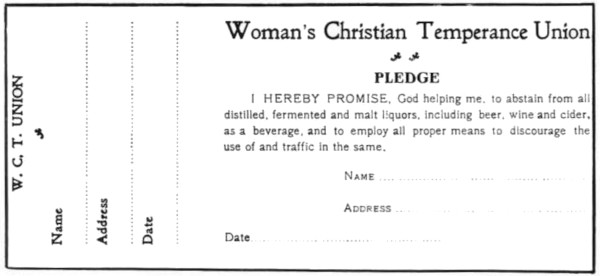
A branch of the W.C.T.U. operated in Wakefield in the 1930s. In 1938 Mrs. C. Stevenson was president, and Mrs. Mabel O'Hara, secretary. Members included Mesdames C. McCorkell, Taylor, R.S. Chamberlin, Edith Stevenson, McCuaig, and A.J. Earle. A monthly meeting opened with a devotional period, a collection, a reading of “6 reasons why Church members should belong to the W.C.T.U.”, a report from a McLean’s Magazine article on “R.C.M.P. fining rum runners $1,600.”. The women studied the life and work of Frances Willard, and worked towards temperance courses. One of these was a “scientific temperance course” for children, with certificates awarded. The women used what influence they could in their earnest endeavour towards temperance, and in 1942 petitioned their Member of Parliament in protest against the shipping of beer to members of the Overseas Expeditionary Force. In 1943 a war savings stamp was given to each of nine children writing on the National Temperance Study Course. That year a decision was made to discontinue meetings for an indefinite period instead of formally disbanding.
Young People’s Organisations and Sunday Schools
The first mention of Sunday classes in Methodist Circuit records indicated that study groups were conducted, usually with a class leader, and were apparently for young and old.
In 1873, of the many who were received into the Church, following special services over a ten-week period, “Some (were) heads of families, and others... young people connected with the Sunday schools, who give promise of usefulness”.
The ‘Christian Guardian’ recorded a special event in
‘A Christmas tree in connection with the North Wakefield Sabbath school. An attractive programme consisting of readings, recitations and music, was rendered, and short addresses delivered by Rev. G.D. Bayne, B.A., and the pastor. J.R. McKinnon, Esq., the Superintendent of the school, occupied the chair. The tree was laden with an extensive array of presents, and Santa Claus was present to perform his pleasing duty of distributing gifts.’
The earliest Annual Report of the Presbyterian Church which we have, is that of 1915 when Miss L.H. Macfarlane was Superintendent of the Sunday school in Wakefield. Louisa Macfarlane was bookkeeper at Maclaren’s store for about thirty years, and was a devoted church worker. The following year, H.M. Cuthbertson had relieved Miss Macfarlane as Superintendent, and Miss May York was secretary. In Masham, Mr. Thomas Reilly was Superintendent and Robert Pritchard, Jr., secretary treasurer. There are notes of Rally Day, Christmas entertainment and socials, collections for missionary purposes, and expenditures on maps, cards and catechisms. Investments were made in a cupboard for six dollars, in six blackboards for $9.61, and in a hymn book for the church, $4.71. Special collections were made over the years for such causes as Belgian Relief Fund ($14.00), Armenian Fund ($34.00), and $25.00 for a Victory bond in 1918. Despite the war, a Sunday school picnic was apparently afforded that year, their expenses being noted at fifty cents.
Mrs. C.C. Peterkin was in charge of the Methodist Sunday school in Rupert from 1906-1919, and Mr. Robert M. Earle was Superintendent in Wakefield from 1903-? 1925, when he became responsible for the United Church Sunday school until about the mid thirties.
A Young Girl’s Guild was active in 1926 in connection with the United Church, Wakefield/Farm Point and Cascades, when they Participated in a concert and Christmas sale. Their efforts enabled them to assist the choir with a donation of $25.00 and the Bethany Young People’s Society with ten dollars. This group was approached by the Ladies’ Aid to supply new floor convering for the Manse kitchen in 1928.
Charles Maxwell and James Reilly assisted the minister in organising a Young People’s Society in 1929 in the Alcove Church, and there were similar groups in Wakefield, Rupert, Farm Point and Cascades from the 1930s.
The C.G.I.T. functioned in Wakefield in the ‘40s and ‘50s, and as well as their study groups, they had sleigh rides and Hallowe’en fairs, Mother and daughter banquets, and purchased literature and song sheets with money raised.
Under the auspices of the W.M.S., Baby Bands and Mission Bands operated from 1920, their studies and fund raising, collections, etc., being directed towards Missions. The Christian Education Committee took over the responsibility of these groups in 1957.
The Sunday schools have studied from a variety of sources: the Bible, “Child's Own”, Story Hour, Bible lessons, and United Church Publishing House material; and in 1970 the New Curriculum was introduced. This new approach to Old and New Testament stories and Christian living, with attractive hard-covered books for each pupil, designed for different age levels, was generally well received, and continues to be used in the Sunday schools.
The White Gift service was introduced in 1949 with the children participating in the church service and gifts of food being brought for distribution to a worthy cause.
In 1950 the gift of a bible was made by Mrs. Phelps to each Sunday school pupil in Rupert, in memory of her parents Mr. and Mrs. Joseph Pritchard. In 1971 the Alcove and Rupert Sunday schools united under the leadership of Mrs. Weldon Brown.
The church schools have always been blessed with most dedicated Superintendents and teachers, all deserving of mention; those whose service was outstanding were: Thomas Reilly, Robert M. Earle, Mrs. Peterkin, Mrs. Bernard Sully, and Mrs. Ernest Trowsse.
Christian Education Committee
by Mrs. Leyton Woods.
This Committee was set up after the arrival of the Rev. Bacon in 1957, with Mrs. Lawrence Cross as its first chairman, and representatives from Sunday schools, Women’s Auxilaries and the Men’s Club. Its purpose is to enrich the quality of worship, work, fellowship and witness of the church in its daily life; to reach children, youth and adults, and to deepen congregational concern for Christian Education.
An early activity took the form of a joint picnic in the summer at Lac Philippe. An open-air worship service was followed by a picnic lunch supplied by ladies of the three congregations, then games, races and swimming. Now an annual event, this begins with a service in the Rupert Church, with the picnic taking place at Valley Conservation Club, near Rupert. The Baby Band was reorganised in 1963 with a new name, “Nursery Roll”, under Mrs. Bruce Moffatt's supervision. Twenty-seven families were enrolled; each family with a new baby being visited by a member of the Nursery Roll Committee.

The year 1965 saw the purchase of a movie projector financed by all church groups, for use in programmes from nursery to senior citizens. “Messengers”, a mid-week group from grades 1 to 3, flourished under Mrs. Nora Broom’s leadership until 1967, then under Mrs. Winifred Woods, Mrs. Heide Martin, Mrs. Carlene Jamieson and Mrs. Marion Simms, and was discontinued in 1974. “The lighthouse” at Alcove Community Hall was operated by “teens and parents” as a meeting place for young people on a weekly basis. In 1969 the Senior Citizen’s Group was organised, featuring monthly gatherings with Programmes and refreshments provided by the U.C.W. and Anglican Guild. Weekly courses were provided in 1975 by the Adult Education branch of the Regional School Board of Western Quebec, and included painting and weaving. Since 1971 the C.E. Committee has been financing one child to Camp Bitobi, and in 1974 one adult to Conference. The Youth Celebration Choir has been assisted with purchases of musical supplies. The Committee is responsible for recruiting Sunday school teachers, and has helped to furnish the new Alcove/Rupert joint Sunday school. Those serving as chairman have included Mrs. Lawrence Cross 1958-66 and 1971-74, Mrs. Kay Nesbitt, Mr. Jack Morrison, Rev. L. Lewis, Mr. Cyril Payne, and Mrs. Doreen Daly.
The Wakefield, Alcove And Rupert United Church Men‘s Club 1958-1975
by Brian McGarry
President 1974-75
W.A.R. Men’‘s Club
The Wakefield, Alcove and Rupert United Church Men’s Club was founded by Rev. Dr. Leonard Bacon, February 24th, 1958, who was the Minister for the pastoral charge of Wakefield, Alcove and Rupert. When Rev. Bacon suggested the formation of the men’s group, some skeptics prophesied the Club would not last more than six months. By February 24th, 1958, there were sixty members and at the end of a second year of operation (April 1960) there were 137 fellows in the Club. The organization is now completing its seventeenth year of operation, averaging more than seventy men at the dinner meetings and still holding the record of the largest United Church Men’s Club in Canada.
The late Robert Golding was the first president, with Rev. Bacon serving as honorary president for this initial year of operation. The format has changed very little over the years; monthly dinner meetings are held from October through April, the meals being catered by the five United Church women’s groups in the area. There is a short devotional period, a business session and guest speaker at each meeting. Officers of the Club hold at least one additional meeting during the month to plan programmes and community service activities. The programmes have varied but the object is to introduce timely topics whereby all members can participate in dialogue and debate (examples: alcoholism, birth control, separatism in the Quebec Province, Eskimo rights, agriculture, the United Nations). Service projects have also run a wide spectrum. Financial aid has been given to such causes as: Crossroads Africa, the Springhill Mines Disaster Fund, local sports and recreation, the Gatineau Memorial Hospital, Boy Scouts and Girl Guides, sending youths to Older Boys Parliament and purchasing Christmas hampers for needy families. Other projects haven't necessarily involved a monetary donation, but rather, man hours donated by club members; for example, work parties to help victims of fire; the collection and distribution of second-hand toys repaired by men in a minimum security camp; the building of a barn at Brookdale Farm (a home for deprived children); the planting of trees; running a public speaking contest for students; conducting church services in the ministers absence.
Even though the Men’s Club is situated in a rural pastoral charge, men have been attracted to the Club from all walks of life and, more significantly, from many religious persuasions. There are business and professional men, farmers, civil servants, students, Roman Catholics, Anglicans and agnostics. A further accomplishment of the Club is its ability to convince men (some of whom have little formal education) to accept office and responsibility.
Although the Wakefield, Alcove and Rupert Club joined the “National Association of A.O.T.S, United Church Men’s Clubs” (Charter No. 319, dated November 3, 1960), it sees itself primarily as a local endeavour encouraging community fellowship, education and service. The Club has been honoured on several occasions, being mentioned in a book ‘The First Half Century of United Church A.0.T.S. Men’s Clubs’ (author Jack Banks, published in 1974) and also in a former United Church booklet ‘The Bridge Builder’ (September-October issue 1966). At the National A.O.T.S. Convention held in Ottawa, August 1975, the W.A.R. Club was honoured for its years of accomplishment. At the same Convention, the Club nominated its founder, Rev. Dr. Leonard Baconas, a “National Life Member” of A.O.T.S. Men’s Clubs.
This somewhat unique group also involves the ladies in the community and not only as servants of meals. Once a year the Men’s Club cooks and serves a meal for the ladies of the area at a United Church Women’s dinner meeting. In addition there is a year-end party where the men provide the entertainment which, on occasion, has involved the staging and production of a “play” by Club members. The play has met the twofold purpose of entertainment and a method of raising funds; however, the primary money making method for the Club since 1961 has been the sale of “Christmas Peanuts”.