

Churches and Cemeteries
Fiftieth Anniversary of Our Lady of Sorrows Church Venosta, 1943-1993
Original document  31.4 MB

The following are selected notes from the publication.
The Homecoming
Come home with us, back to the hills, back to the valley, back to Venosta.
Share with us the memories of our Church, our school, our very active societies and sports clubs and remember especially the people who touched our lives in such a powerful way thereby weaving the fabric that reflects the last fifty years in the life of Our Lady of Sorrows Church.
Those were not plentiful times in the monetary sense but were filled with the wealth of love and laughter. Our strength came from friends, family and neighbours. Probably there were times when we laughed so that we would not cry but that is the beautiful courage that comes with our Irish heritage.
Remember the joy that ran rampant in Venosta when we realized that we would finally have our very own Church.
Join us now on our path to the past.
The sleigh bells, on that first Christmas eve, rang out in exultation.
The first weddings, the first baptisms, the first marriages in Our Lady of Sorrows were causes of joy and delight.
Sadly, we also had funerals. At funerals, it seems that Francis, the bell, actually cries (Please see story on Francis in another area of the booklet).
We owe a debt that can never be paid to those who gave so unstintingly of whatever they possessed, whether skill, money or labour to ensure that our Church was a fitting tribute to Our Lady of Sorrows.
We sincerely hope that you will enjoy this little walk down memory lane.
None of this souvenir publication would have been possible without voluntary commitment to the project of many very dedicated people. We are blessed in many ways in Venosta but our greatest blessing is our people who give so freely of their time and talents. Days were spent in research, typing, writing, procurement of photographs, etc. A heartfelt thank-you to anyone who helped in any way.
We gratefully express our appreciation to the many parishioners who answered our requests for family histories of events, for photographs and for sharing their memories. Monetary contributions were most generous, very welcome and deeply appreciated. We have not knowingly omitted anything that anyone in the parish wanted included. We do not forget our summer residents who are so generous in their support, financial, physical and psychological and who freely share their talents.
We thank you from the depths of our hearts for helping us, even if its only by reading our simple creation.
It was a work of love and could not have been done without you.
Eva Henry Desormeaux (Editor)
Muriel Henry (Research)
Our Mission
Our Mission of Our Lady of Sorrows celebrates this year the 50th anniversary of its foundation.
In 1943, the Central Gatineau Church belonged to the diocese of Ottawa. Archbishop Alexandre Vachon thought that Venosta was ready to be detached from St Martin’s and to forma Mission. Having a great devotion towards the Blessed Virgin Mary, the Archbishop dedicated this new community to Our Lady of Sorrows, the fourth one in the area under Mary’s special care after “Le Trés-Saint-Nomde-Marie” of Lac Ste-Marie, ‘Our Lady of Mount Carmel”, Kazabazua, and the ‘‘Visitation” of Gracefield.
Why such a sad dedication? Let us remember that the dreadful conflict of 1939-45 that claimed millions of lives in Europe and thousands from Canada was on. To foster peace and mercy at home and in the world, this sad part of the history of the world is to be remembered, and in a way, our Mission does it.
At the beginning of the second half century of our existence as a mission, let us ask the Blessed Virgin Mary, who was so united with her Son in time of distress, to be more concerned with peace and justice in the world, to be more convinced to pray for that purpose and to continue to be, in our own Christian community, witnesses of what we claim for the world. It is, I think, our special task as members of the Mission of our Lady of Sorrows.
Bruno Godbout c.s.sp.
Parish-Priest
A Message
The Church History - a treasure chest of memories; memories associated with years of your church life captured in print and photographs.
In May 1993, Our Lady of Sorrows will celebrate its 50th Anniversary. When the Church celebrated its first Mass in 1943, some of us were very young. Some of our parents were among young families in the community. We are now in our golden years, while our dear parents, the foundation of Our Lady’s have left this earth.
An Anniversary Committee has been meeting regularly to plan projects throughout this year, and a highlight has been the publication of the church records to trace our history, to recall old friends and to develop lists of parishioners who are invited to these occasions. Some of the present parishioners were here fifty years ago and it is revealing to see the different hairstyles, the changing of hair colors, the expanding waist lines, and the wrinkles and creases that weren’t on our faces back then.
As one who has been here for more than fifty years, it has been the most interesting, sometimes challenging, yet rewarding decades of my life. We have seen the Church develop from infancy to maturity with an excellent reputation. May we continue to enhance this Mission to hold our heads high with pride, as we say, “I was baptized (confirmed, married, etc.) at Our Lady of Sorrows Church.”
Much success in your future endeavours.
By: Betty McLaughlin
(Chairperson, Anniversary Committee)
Nov. ‘92
Background
by Eva
The village of Venosta was settled by Irish immigrants, most of whom arrived in the area in the mid to late eighteen forties. Although it broke their hearts to leave their native land, they sought freedom to practice their faith and to raise their families, unrestrained by tyranny and famine.
Many of them were attracted to the Gatineau Hills by the lumbering and agricultural industries and doubtlessly by the scenic beauty that reminded them of home.
Life in the new land was far from easy. One of the greatest challenges was to find a place to worship. Often, it involved walking about thirty miles carrying a baby whom they wanted baptized. When St. Martin’s of Martindale was established, things became a little easier. Nevertheless, it was still a hardship for many to get to church. Roads were closed in winter and travelling by horse and sleigh in the bitter cold was particularly difficult, if not impossible, for the very young and the very old.
Therefore, when Father Francis Tierney informed Bishop Vachon by letter that Venosta was ready to start construction of a Chapel, there was an air of jubilation. Since Christmas Eve, 1941, Mass had been celebrated in the upper level of the Blacksmith Shop, so everyone now was aware of how wonderful it was to go to Mass in the village. To think that this would now be a permanent situation was an answer to prayers, a dream becoming reality.
This was not a great period in our history. A terrible war was being fought in Europe, the depression was just ending and manpower, money and material were all in short supply.
None of this deterred the people of Venosta. They simply rolled up their sleeves and went to work.
Mentioning names is hazardous because almost the entire village was involved in voluntary projects.
Men, women and children gave freely of their time, energy and talents. If they didn’t have money to give, then they donated logs or labour or something else of value. Everything that gives our Lady’s its special beauty was donated.
Those of us who were there fully appreciate the task that was at hand.
Those who have been born in the last fifty years have justified the faith that their ancestors had in them. They have gone into the world and made us proud, but more importantly, they have never forgotten our Lady’s and continue to give their love and support without question. May our Lady Of Sorrows live on forever!
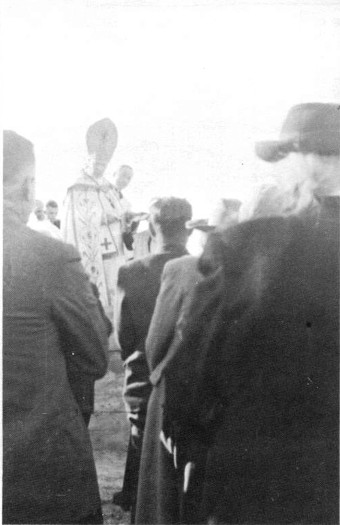

Blessing of the cornerstone - 11 October 1942.

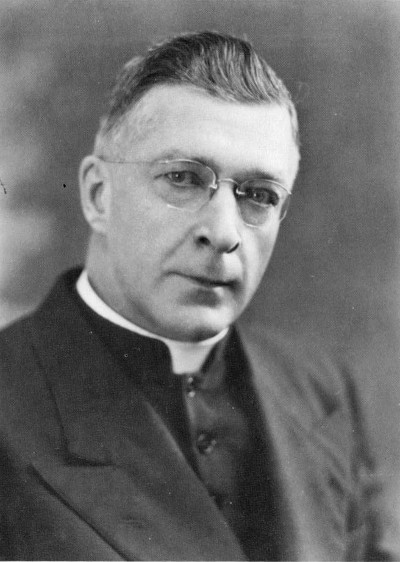

Always Here in Spirit
Our Lady of Sorrows Church coupled with Our Lady of Loretto School have been focal points for all in our community. In the church we worshipped every Sunday, attended First Fridays and frequented the sacraments together. In the school we were instructed in religion and the academic subjects with plenty of time for fun which nurtured lifelong friendships. According to today’s standards this may have been a dull and secluded life; but if you consider the finished product we see that most individuals are making valuable contributions to Church and society today.
Circumstances have taken many of us away from this parish but our genuine concern and love keep bringing us back. As summer residents, we hope that the faithful can maintain the parish and the spirit of our forefathers.
Our personal wish for Our Lady of Sorrows 50th anniversary is that we will always reverence the elderly for their wisdom and cherish the young who can fulfill our dreams and sy aspirations.
Mavis and Patrick Henry
Boyhood Memories of Venosta Church Picnic
by Bruce Kealey
At the age of four, I distinctly remember the aroma of my mother’s fresh homemade pies and cakes. All these delicacies were neither to be touched nor tasted by the wide-eyed boy for fear that he would not be allowed to attend the annual picnic. My father was pre-occupied for a number of evenings prior to this upcoming event. Preparation of the church grounds filled every spare moment of his time. He had to squeeze-in picnic chores between jobs at our family business. Luckily for me, from my home, I could see the fairgrounds in the distance and was convinced that sufficient progress was being made. I was sure that our parish priest, while making an inspection, would not fire his male parishioners.
Finally, Saturday morning arrived to find my father had left with all the baked goods. Thank goodness my mother was still at home and would get us children ready for this great event. My four sisters and mother accompanied me. The picnic fever took hold when I could smell the french fries and hear the noises prior to entering the grounds. My two older sisters quickly searched out their friends but promised my mother that in their turn, they would each help take care of me.
In front of the church, I was totally amazed to see so many cat-shaped faces waiting to be knocked over by tossed balls, with people being egged on by the man in the booth. Right next to this attraction, I quickly understood why a local woman was shouting threats at two teenage boys. At the back of the booth, small sticks were being pushed through the cracks between the boards which stopped the spinning of the wheel of “crown and anchor”. There were many games of chance, darts, bingo, paddles, something to do for everyone! Everything imaginable in a young boy’s mind was also available for sale at these booths.
While standing near the horsedrawing area, I noticed many well-dressed, cigar smoking men with many sporting gold watches on chains in their vest pockets. It seemed to me that every horse in the parish and surrounding parishes must have been competing. I remember vividly that while standing there, lost in the midst of strangers, one of my older sisters and her friends asked me to help them collect “Planters” peanut bags. With ten empty bags and a letter to the company one would receive a free colouring book. This hunt led me to the right of the Vestry steps, where a pillar of smoke rose in the air, Bent over a cook-stove and open pit was my aunt and a local gentleman cooking and heating baked beans for the many meals to be served over the two day period in the basement of the church.
The day passed very quickly! When darkness came all the children were treated to a movie in the outdoor theatre set up on the lawn. The movie was “Bud Abbott and Lou Costello,” preceded by the “Three Stooges.” The majority of adults were square dancing on the huge outdoor platform to live traditional music to a well known local square dance caller, Willard Rooney. My parents took me home that Saturday as a very tired boy; however, convinced that I had to go back for more of the same on Sunday. This occasion was truly the highlight of a four year old boy’s summer.
Sisters of Charity
by Peter McLaughlin
Any history of the evolution and development of Our Lady of Sorrows Church in Venosta would be incomplete without mention of the major contribution made by the sisters. The Sisters of Charity of the Immaculate Conception, an order based in Saint John, New Brunswick, arrived in Venosta in 1946. Over the next 26 years, they were to play a pivotal role in the successful development of the Christian community that today we take for granted.
The sisters arrived in 1946 to a small two-room school. At the beginning, there were no living quarters. Wilfred and Gladys McLaughlin kindly provided the sisters with the use of their new home until such time as the school was renovated and living quarters, a small chapel, etc. were added.
In the years that followed, the various sisters who came and went provided first class education to the students. In addition, and more importantly in my mind, they formed a vital partnership with our parents and the parish priests in the character development of the youth, They were able to instill a sense of discipline in their students which extended beyond the school itself and complemented the deep rooted faith of our parents. Faith and discipline were hallmarks of the training and teaching provided by the sisters.
It would be impossible to mention the individual contributions of the various sisters who served in Venosta. There are three sisters however that come to mind as having made a special impact on all of us.
First, there was Sister Theresa Marie, one of the “originals”, who arrived in 1946. She was especially qualified for her primary grade assignment and made the transition from home to school life much easier for many of us.
Secondly, there was Sister Julia, a strong disciplinarian who demanded and got the most from her students. She was the best teacher this writer ever had and a great friend to all of us who knew her.
Last, but certainly not least, was the inimitable Sister Rosemary Costly. Sister Costly touched the lives of many people in the Gatineau be it through the school, church or sports. Who can ever forget her die-hard support of the Venosta Shamrocks and her beloved Montreal Canadiens.
On behalf of all parishioners, past and present and for our forefathers who are no longer with us, we salute the sisters and thank them for all they did for the Church and the community.
Recollections of Our Lady of Sorrows
By Irma McCambley Peck
My first memories of Our Lady of Sorrows Church was sitting three seats from the front, downstairs, centre row on the right with my grandparents. I presume my grandfather needed to accomodate his loss of hearing in his golden years, thus he needed a seat near the front.
From that pew I remember Martin Brown and his mother sitting directly in front of us, and in the very front pew was Mick-Joe Kealey, his wife Mary and Bernard. I always wondered how Mrs. Kealey managed to braid her hair and fix it so neatly on the back of her head.
Having a handicap, with no ramp did not deter one’s attendance at Mass. I can see May Mullin sitting up front in her wheelchair and over to the left Gertrude McCaffrey wearing dark glasses because she was blind. I know further back in the Church there were several people using canes, etc., but they were there - joining in prayer.
Later, I recall several nuns occupying a front pew while one nun played the organ upstairs and directed the choir.
I have fond memories of Sister Teresa Marie during my first year of school at Venosta. Our life at school was very much interwoven with the Church nearby.
Of course for Mother’s Day we made neat little cards. These cards were spiritual bouquets for our Mothers. To fulfill all our promises we had to visit the Church at recess and noon hour. Hats were necessary, so we learned how to fold a kleenex or hankie and fasten it to our hair with a bobby pin. Only then would we dare enter the Church. Honesty was important, so we counted the trips around the Stations of the Cross, so vividly did they tell the story of Jesus’ death, especially to a young child. Visits to the Blessed Sacrament and other prayers, were all included in our spiritual bouquets.
Running, tag, skipping and ball were relegated to the back burner for the time being.
During my first month in grade one, Sister Teresa Marie was notified that she must prepare grade one for Confirmation. This meant not just one Sacrament, but a hasty preparation for First Confession and our First Communion. Also, grades two and three would receive Confirmation. We were kept busy between our classroom and rehearsal up at the Church.
Of course everything came off just perfectly - the girls from grades one, two and three, etc. looking angelic in their white veils, socks and dresses - the boys mostly in suits with the white arm bands hanging neatly between the shoulder and elbow. With the Bishop only visiting our Church every three years, it meant that some families had more than one boy or girl being confirmed on the same day. I imagine that veils, dresses and arm bands were probably borrowed from family cousins or friends. At our house it must have been hectic with Keith. Elaine and myself all making our Confirmation on the same Sunday - Mother outfitted us except for my veil which was borrowed and had to be hastily returned to another parish where the Bishop was scheduled to visit immediately after confirmation at Venosta.
I recall being nervous about the “slap on the cheek”, that I would receive from the Bishop. Of course it was not as I had anticipated.
Then came the missions - a week long event - mornings and evenings. It was those mornings that I vividly remember. Getting up in the dark to go to Mass. The house would be bustling, grandparents - Bigmama and Johnny as we called them - brothers, sisters and parents all getting ready. We took two cars with some of us sometimes riding the back seat of my Grandpa Johnny’s ‘31 Ford. It was fun - he drove faster than Daddy, especially turning into our laneway. Mass and communion in the moming and in the evenings a good sermon. I remember the visiting missionary wearing white robes. But the interesting part of a mission was what happened in the basement of the Church. Into the back comer and down the stairs we went and there spread out on tables were the medals, scapulars, prayer books, beads, little cases for beads, etc.. Somehow we always managed to need at least one of these articles and it was purchased for us. In the mornings I think Mass must have been celebrated at 7:00 AM because the electric lights were on in the Church. Immediately following Mass we exited Church and drove north to the farm. It was a mad rush to eat breakfast and I remember Mom frantically packing lunches and getting us out to the school bus. Then in the evening the rush to complete the barn chores and head down to Church again. Of course, with the lights on in the Church it took on a different atmosphere - I liked it.
The Forty-Hours devotion and Retreats were also a part of our growing up years.
Another devotion I remember was the Holy Hour which was a set hour, observed once a month by the ladies of the Parish. Mom’s was from 1-2 PM when she was praying at home and somehow it seemed that during that time, there was always something that you just had to ask her.
Christmas was another favourite - then the crib came out and we could line up to visit the manger scene. It fascinated me - the straw spread out - I can still see it under the animals’ feet.
Altar boys - I remember both sides of the altar having pews and the bigger and smaller boys usually dressed in black and white, but at Christmas the red and white looked very festive. The server on the right was the leader and of course these boys learned ail the responses in Latin. Being a youngsterI figured they were ultra intelligent and bilingual - English and Latin.
The annual Church Picnic was another event centered around the Church. Families and friends would return to join in the festivities. Of course, for Children it was all fun, but for the men it meant setting up booths and a platform for dancing. For the ladies it entailed the making of pies, salads and serving in the basement of the Church. Friday at home, then all day Saturday and Sunday the volunteer ladies prepared the dinners and suppers and later washed the dishes. I don’t believe they suffered any sunburn on picnic week-ends, as they remained in the basement most of the daylight hours. All this was. done to obtain funds to keep their Church in the green and not in the red.
The basement also was used as two makeshift classrooms, while Venosta school was being renovated. I can remember the concrete floor and the classrooms being rectangular shaped, running the entire length of the basement. The seniors on the north side, the primary on the south, and the short rows of desks.
I guess it was during that school year that I had the experience of having my first tooth extracted in the vestry of the Church. The dentists and nurse visited, set up their clinic and I can recall looking at the tall set of cupboards just before that ordeal. Even though my first dentist’s visit occured in the Church, it did nothing to help me relish a visit to a dentist in later years.
I often think about the pews. Each family paid a pew fee - this helped with expenses and you knew where you were sitting each Sunday. But to this day I am baffled as to how the families managed to fit into their pews. I know we overflowed from the back pew down into our grandparents pew. With Keith becoming an altar boy and Elaine singing in the choir, we squeezed in as a family. | remember every seat being filled and I can still recall where most of the families sat. I guess the non-ownership of pews is more practical today, as we are a mobile society and find ourselves worshipping in any number of parishes throughout the year.
There was one disadvantage in having your pew upstairs. In my later teen years I can remember going down and up the back stairs while the guys stood along the staircase. Heads down, hands clasped we somehow made our way down and back up after communion - back to the security of our pew - the stairs we did not relish.
I do not remember the actual construction of the building, but | can imagine farmers coming from the many gravelled roads, joining the village folk and together they built a place where men, women, children and babies could join to worship - thus forming a Church. Our priests come and serve, sometimes re-visiting for marriages or funerals, but the families will always have their roots deep in the soil. Thus they cherish the fact that they can be married, have a child baptized or celebrate a funeral in the little country Church. Last Sunday I was reminded of the continuity of local families, when I saw two young mothers holding their babies, while the grandparents sat nearby.
To sum it up, it is the Church where J made my First Confession, Communion, Confirmation and celebrated marriage - the Church where I had my first tooth pulled, the Church where, for a time, I went to primary school, the Church where I enjoyed picnics, the Church where, as a family, we were joined and supported during the funerals of our parents, grandparents and neighbors. It is the Church that | cherish being able to exchange the handshake of peace and the Church I now am wishing a happy fiftieth anniversary.
Memories
By Earl St. Jean
My earliest memories of Our Lady of Sorrows reach back to a time of early childhood, when memory is wholly unreliable. However, it is those earliest memories, shaped and coloured by © the fantastic landscapes of our childhood, that sometimes remain with us forever.
Sunday Mass in our parish was the focal point of the week. A major social event in addition to the Spiritual. A precious time of rest when the heavy endless chores of farming or bush work could be set aside temporarily. The period after Mass was a particular delight when many would meet at the store or the service station for a coke and a chat. There, if we were lucky, we would be treated to the rich Irish tradition of story telling as carried on by some of the masters who lived in our midst - Emmanuel Kealey, Fred Kealey, Pat Lacharity. Story tellers who could take the trivial details of our daily lives and elevate them to fold-myth.
I must be honest and confess that I didn’t grasp the full concept of what Sunday and Mass were all about except that something important was taking place. I recall dressing carefully in the best clothes available, shining my shoes meticulously and most important, being on time. There was the peculiar childhood privilege of being able to have some breakfast while the adults were forced to fast, whatever that was.
Once at Church the proceedings were very mysterious, yet even at that tender, uncomprehending time in our lives, we were learning to concentrate and be quiet. My earliest contemplations were centred on a careful study of the ears belonging to the elderly gentleman seated in the pew ahead of us. | remember marvelling at the enormity of them and the tufts of hair that sprouted thereon. My uncle, who was several years older than me and knew about such things, assured me that potatoes could take root and grow in there. Unfortunately, I never managed to witness that phenomenon.
This innocent pre-school world soon came to an end when, upon entering grade one, the good Sisters of Charity took on the task of giving us our first religious instructions and preparing us for our first communion.
We had daily drills with the Baltimore Catechism and the latest in teaching aids - strange smelling mimeographed sheets with drawings of the many vestments and objects found on the altar - that we dutifully coloured and memorized. Somewhere in time the Jesuits had determined that at age six or seven, we were sufficiently mentally developed to embrace the higher concepts of spirituality. I can only say that in my case they were being somewhat generous.
After countless hours of patient instruction in learning our prayers we were ready for rehearsals and were led over to the Church. In the fertile world of our children’s imaginations we were aware that something of great importance was soon to take place. The Church began to take on new significance in our lives. Ican remember Sister Victorine taking us over for a dry run. With quiet reverence we were able to study the inside of the Church without the whole congregation present or a Mass in progress. This was the biggest building any of us had likely seen. The sheer scale was over-whelming. The great cathedrals of Europe could not have inspired more awe. We were shown the confessionals and taught what we were to say once inside. The dark, musty cubicle with its crucifix and tiny kneeling rail lay behing the thick red velvet curtain. We were taught that once inside, when the priest slid aside the partition behing the little holes, we could confess our sins and receive God’s pardon.
My mind flashed back to the illustration of three milk bottles in our catechism. On the left, a clear wholesome looking bottle representing a soul in a state of grace. In the centre, a bottle tainted with dark spots representing a soul whose owner had committed venial sins. On the right, a bottle filled with some sinister, inky black liquid representing mortal sin. I recall great debates raging among my classmates as to what transgressions might fall into the venial or mortal category, but all of us vowed that we would never fall to the perilous condition of that third milk bottle. Several of us took to keeping a tally of perceived sins as they occured with marks on the flaps of our crayon packages. We would be ready.
Our world was expanding rapidly under the Sisters’ tutelage but the mysteries were growing more complex even as they were explained; masses and the children of God took flight into Egypt. It must have been a huge plane. Was it one of the new jets? The Holy Ghost actually lived in the Sacristy Lamp. Was it a sin to stare at it too long? Was it a sin to hope we might catch a glimpse or perhaps find a dove’s feather?
Days of indulgence posed a real problem. If we said our prayers and stored up several thousand days, could we then go on a binge of sin and be safe till we used them up? Who were the Pagan children that we gave our pennies to? We knew that the brothers cared for them in that exotic, far-off world called the Scarborough Missions. What a wondrous place it must have been.
If memory serves me correctly our first communion was planned for around Easter. After more careful drilling we finally joined the confessional line-up to take our place as members of the congregation. I can vividly recall standing in the line-up and being preceeded by an older lady. This woman’s piety could never be called into question, and she was looked upon as one as close to a living saint as was possible. I thought of what tiny sins she must have. Her milk bottle would be virtually spotless. The trouble arose when upon standing outside the confessional I was soon able to hear her unique Irish brogue drift out in a stage whisper that could be heard in the next county. I was horrified, I looked around, No one seemed to hear or pretend to notice, Everywhere my inquiring gaze was met with downtumed eyes and shuffling feet. Had they lied to me? When my turn came would everyone be able to hear me? Would my horrendous list of sins be broadcast to the entire community? Suddenly the thick red velvet curtain looked very flimsy. | do remember going in when my turn came, paralyzed with fear, carefully repeating my lines to calm my terror. “Bless me Father, for I have sinned.” Eventually the partition was slid back and I peered up and plunged ahead. I was halted part way by the brass tones of the voice of doom. “Slow down and speak up” Father Brennan commanded. Somehow I muddled through and remember emerging flushed and already saying my penance, determined never to sin again.
In due time our class made it through and assembled on a glorious sunny day for our first communion. The girls, all in white and positively angelic. The boys, squirming inside wool suits and teal neck ties with our snow white shoulder flashes declaring our purity.
All went well and we emerged from Church to smiles from parents and poses for photographs. Secure in the knowledge that the things we had learned and the rituals we had taken part in would change us forever.
Soon we would be passed on to Sister Ann Theresa and the intricacies of Latin - boot camp for altar boys - but that’s another story.
The Blessed Wells
by Eva Henry Desormeaux
We’ll have to tell this story the way that it has been told to us for generations. Not much written history exists about The Blessed Wells, but the lore has been with us all our lives.

Father Casey was Pastor of Martindale Parish from 1876 to 1878. Shortly after he arrived in the area, he had a dream in which he was told to find a spot in which three different types of water met in the form ofa cross. In Venosta, near the Borough Road, he found a spring fed well and a salt well, with a creek (Brandy Creek) running between them thereby forming a cross. He blessed the wells and in doing so made several predictions. One of the most often heard of those predictions was the one that said that a hotel would never flourish in Venosta. Many prophecies have been attributed to Father Casey. A little suspicion exists that some temperance-minded ladies created a few of their own. One such story claimed that you could choke to death if you attempted to mixed Blessed Well’s water with whiskey. It hasn’t been possible to find anyone to confirm this for us.
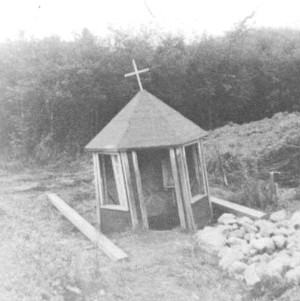
There have been many ghostly sightings around this area. We can’t confirm these either but what we are certain about is the mysterious, even eerie atmosphere that is peculiar to the area.
Father Casey left a Litany of The Blessed Wells, which appears here as it was written by Gertrude McCaffrey many, many years ago.
There is now a Casey Road in Venosta. It was built by Fred McLaughlin in memory of Father Casey and it crosses through the old Dempsey farm.
Unfortunately, a great deal of damage was done to the wells when road construction took place a few years ago. Nevertheless, the Blessed Wells still exist and the mystique is still there.
Remembering “Our Lady of Sorrows”
by Laurel Doucette
When I dip into my early memories of Venosta Church, I retrieve an odd collection of fragments.
White gloves. Polished shoes. Hats with veils.
The stifling smell of wet woolen snow suits and mittens in the chair upstairs.
The freshness of cedar boughs in the basement dining hall at Church Picnic time.
Drowsy summer sermons of interminable length when we ached to be outdoors.
Troops of women, their heads turbaned with scarves, scrubbing, waxing, and polishing on days when “cleaning bees” were organized. And crowds of children who inevitably picked the same days to make prayerful visits to the Blessed Sacrament, thereby tracking mud over the length of the freshly cleaned floor.
When we were very young, the wonder of sleigh bells in the frozen starlight of Christmas Eve. Every summer, the marvellous counterpoint of fiddle music and chanted square dance call on the sweet damp air of a Church Picnic evening.
And people.
The elderly gentleman with the bristly greying moustache which my brother Jack and I mistook for half-eaten Shredded Wheat. We always wondered why he wore his breakfast to Sunday Mass.
Mrs. Wiggins, who often joined us to break her fast after walking out from her little house beside Brandy Creek to make the First Fridays. How gladly we volunteered to fetch her supplies from the store while Mother walked her up the road to our house! We knew that our reward for a small service to an old woman would come very quickly. A fresh sealer of strawberry preserves, retrieved from the storage cellar beneath the kitchen floor, would be tipped into a glass bowl set in the centre of the table, and our modest meal would assume an elegance it did not have on ordinary days.
Sister Teresa Marie, the object of our absolute devotion. And all of the other sisters who came with and after her.
And Mother.
Mother, sending me down the road with bouquets of garden flowers to be delivered to the convent for arrangement on the altars.
Mother, seeking reassurance from Father Tierney that crocheting altar laces on Sunday would not break the Sabbath prohibition on work - then ripping out on Monday what she had accomplished on Sunday, because her worry about working on the Lord’s Day had resulted in a variation in thread tension, and the lace would not hang straight.
Mother, patching a hole in Father Brennan’s surplice with a circle of netting cut - much to my consternation - from my First Communion veil.
Mother, using my brother’s suit coat (cut down from my father’s) to beat out a fire in the vestry, and then laughingly commenting that the exercise had improved the quality of the cloth.
Mother, discouraging an itinerant evangelical from his doorstep proseletizing by the mere act of standing on the threshold, her arms full of the dripping surplice she had been laundering. He wisely decided that her conversion was unlikely, and left without uttering a word.
Mother, like all the Mothers of the parish, tending the Church as they tended us through the seamless round of the year - harvest to All Souls, Advent to Little Christmas, Easter to planting time.
As children, we inhabited a world where the sacred and the ordinary, the spiritual and the material, the divine and the human were one. It was no wonder at all to my childish eyes that the Sunday sunlight shone with a greater clarity and brilliance than on any other day of the week. And when its dying rays at evening Benediction burnished the interior of our little church with the radiance of gold, I knew that heaven itself could not be more beautiful.
The Pond
by Kevin Henry
The people of Venosta have always longed for their own church. Early in this century the good people of this village decided to build that church. On land donated by a local merchant, Dave Havron, the job of erecting the church began. A foundation was dug directly in front of what is now the McCambley - Henry homestead. Lumber and timber donated by local farmers was delivered and piled high beside the newly-dug foundation. Unfortunately, a dispute over where the church should be located resulted in the cancellation of any further activity. The inability to agree on a site led to the abandonment of the entire project. The timber and lumber was subsequently removed but the dug-out foundation remained.
As if in an act of appreciation for their valiant efforts, the good Lord rewarded the people by filling the dug-out hole with good clean water. The place became very popular with the surrounding residents, especially the children who spent countless hours amusing themselves at the pond. The welcome arrival of Spring was always joyously announced by the chirping of the many frogs who were happy to call the pond home. Their beautiful music would lull the children to sleep at night and in the morning welcome them to a bright new day. In the summer the pond was alive with activity. Bluebirds, robins, canaries, butterflies and many other species of birds could be seen fluttering in and amongst the cattails. Polliwogs and minnows swam lazily, enjoying the warm summer days. Summer also brought about the only chores connected with the pond. Each and every Saturday we, (the guys) dutifully carried pails of “soft” water to the house so that our sisters could wash their precious hair before proceeding to the Saturday night dance at the Kazabazua hall. I’m sure all the local guys appreciated our hard work. But it was in the late fall and during the long cold winter that the pond became a magical place, covered by a beautiful smooth sheet of ice. Almost all of the children in the neighbourhood, which included the Kellys, the Maxwells, the McCambleys and the Henrys, took their first shaky strides on skates on this slippery surface. We also had the opportunity to observe skaters who really knew how to skate. I can remember being totally impressed with the elegance and grace of my Aunt Gertie gliding across the ice in her beautiful white fancy skates, On weekends and bright moonlit nights the pond was alive with activity. Noisy, happy children enjoying the cold Canadian winter. The Montreal Canadiens defeating the Toronto Maple Leafs, future Barbara Ann Scotts swirling amongst the players, Rocket Richard getting a breakaway only to see the dog take off with one of the rubber boots that formed half of the net. There are so many many happy memories connected with the pond.
Although the initial intent of the foundation was never realized and the pond has subsequently been filled in, we owe a very real debt of gratitude to our ancestors who had the courage to try and build a church in Venosta way back then. And even though their dream was not fulfilled, the joy they were Tesponsible for bringing to generations of children will always be remembered with much affection and appreciation.
Recollections Glad and Sad
by Eva Henry Desormeaux
When Mass was held in the upper level of the Blacksmith’s Shop, there was a flight of steps to climb that seemed endless. Eventually we would, however reach the top. Inevitably, about three steps from our destination, someone would breathlessly comment: “Guess it'll be a High Mass today.”
* * *
During the war, the demand for metal made it virtually impossible to buy a new bell for Our Lady of Sorrows’ Church. It was possible, however, to procure a used one from a religious institution in Ottawa. The bell was blessed and named Francis, in honour of Father Tierney. Fred and Lima McLaughlin were godparents. During the years this same bell seems to have developed a penchant for reflecting the mood and activities of the parish and there are those who swear that Francis has the ability to sound happy or sad.
* * *
Eleanor Desjardins and Agnes Mulvey were the teachers in Venosta during the construction of the church. They planned a concert which involved most of the students and other parishioners. It was a great success and the proceeds purchased a window for the church and a “Station of The Cross.” One of the plays had cast Mary Daley and Gerard Sullivan in a romantic role. They pursued this role in real life and it eventually led to wedding bells.
* * *
Once a year usually around Easter a “Blessing of Cars” was held in the churchyard. Rumour has it that some “juice of the barley” left over from Saturday night often involuntarily benefited from the blessing.
* * *
We faithfully made our visits to the Blessed Sacrament after school. You always knew who was having a quilting bee at home because the length of the kid's visit would be cut in half. It must have been visions of all those extra goodies and the need to get home before the good ladies devoured them all.
* * *
One Christmas Eve repeatedly comes to mind. Probably because it was picture-perfect. The snowflakes were just the right size and were falling at just the right speed. The appropriate amount of crispness was in the air. The sleigh bells had never sounded so melodious. They rang out from the highway and the side roads. A group of us were walking to church in all of this splendour when, to add to our pleasure, Paddy McLaughlin (Ross’s Paddy) stopped to pick us up. We jumped into the sleigh and we went merrily on our sleigh ride to Midnight Mass.
* * *
On the original altar of Our Lady’s were two beautiful angels, holding lights aloft. They had been purchased with the money found in Earl McLaughlin’s pockets when he was killed in a tragic accident, so early in life.
* * *
When we left home to attend educational institutions in the city, train rides became very familiar to us. Normally they were exceedingly happy trips, especially when returning home. One trip, however, on a bitterly cold January day, was heart-breaking. There was none of the usual silliness. The seat usually occupied by Olive (Daley) was empty. She had become suddenly ill and had not survived. She was now taking her last ride home with us but she was in another part of the train, in a coffin. At the church Francis tolled in sorrow. It was our graduating year.
* * *
It became apparent, as we delved into our past, that the church, school, train, sports and social events were intrinsically interwoven. The train was a mainstay of life. During construction of the church it was the means of transportation of many items to the site. The train brought the mail and it brought our people home. Just as we remember going down to the church “after the train,” we remember going to ball games “after Mass.” Many of the ball and hockey players were or had been altar boys. The qualities that created great sports people were well taught at school and church.
* * *
Together, let us ensure that the next fifty years in the life of “Our Lady of Sorrows” remains creative, energetic, healthy and happy. Lets ensure that this church does live on.
* * *
List of Gatineau Valley Churches.