- HomePeopleFoundersPeople of NoteStoriesTransportRoadRailRiverLoggingThe CutThe DriveSocial ImpactCredits
 Spinning and Weaving in Days Gone By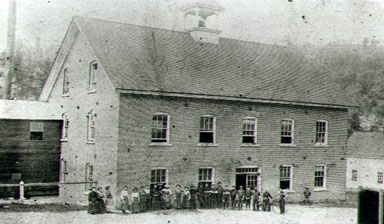
The MacLaren Woollen Mill and employees mid- to late-1800 In the 1850s the MacLarens in Wakefield expanded their gristmill establishment to include a woollen mill. It is doubtful whether any of the local spinsters continued to card their own fleece after this. To be freed of this lengthy process has to be experienced to be appreciated.
Men who had trained in weaving prior to coming to Canada may now have sought employment at the woollen mill. Joseph Irwin, who had settled in Wakefield in 1929, appeared on census returns as a farmer until 1871, when his profession of weaver becomes apparent. To date we have no record of the original weavers and spinners at MacLaren’s Woollen Mill, but some of those who worked there at the turn of the century, and until 1910, are still remembered by older residents of the community. Reg Clarke recounts that his mother, Carry Hyde, loved working on the looms until her marriage to David Clarke in 1905. But it was not without hazard; one of the workers had her apron ripped off when it became caught in the machine. Carry’s sister, Flattie, Maggie Piche (Mrs. Fred Wills), and Sarah Ardis (Mrs. Ben Brown) were also mill workers. The bolts of suiting material and blankets produced at the woollen mill could be purchased from the grand store, situated one hundred yards further east, and run by the MacLarens. There was also the added luxury of having the choice of fabric fashioned into a garment by the dressmaker on staff.
MacLaren’s Woollen Mill stood a little apart from the gristmill, on the area that is at present groomed into a park area. At about the turn of the century, additions were made to this mill, which had been operating for almost 50 years. The first floor was occupied with weaving; the second floor held the carding equipment, and the third floor, the spinning. An adjoining building housed the picking room and a dye room. A photograph of this period shows a staff of about 25 men and women, so there is little doubt that Maclaren’s mill complex was a hive of industry and the largest centre of local employment.
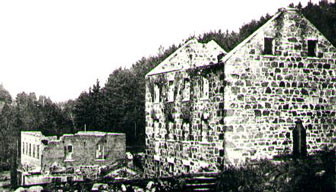
MacLaren Mill after the fire of 1910 As well as providing carding services, fleece was no doubt shipped to the mill from far and near for sale and perhaps, at times, for barter. The end products were wool blankets and fabric for clothing. Woven goods need to be fulled (the process of shrinking and thickening cloth after weaving) and in the case of the blankets, possibly brushed. Dyeing may have taken place at any of three stages: in the fleece stage prior to spinning, after having been spun into yarn, or after having been woven into goods. A race, or long, tunnel-like structure, which ran parallel to the road, was where the fabric could be stretched onto tenterhooks to dry.
The waterpower on the Lapeche River ground the grain in the grist mill, powered the looms and spinning equipment, and produced electricity for the complex as well as the general store.
On the morning of May 17, 1910, a spark from a metal object in the carding mill ignited the greasy wool. The fire that ensued destroyed the entire complex. Although the gristmill was later restored, this tragedy rang the death knell on the Maclaren Empire in Wakefield and the local weaving industry.
Geggie, Norma excerpt from Up the Gatineau! Vol. 20.


